
Temperature is one of the most closely monitored process variables in an industrial plant. A few degrees of variation can affect product quality, energy consumption, equipment life, or even operating safety. That’s why temperature measurement isn’t simply about selecting a sensor with a suitable temperature range. The measurement method has to match the process.
In the real world, engineers measure temperature two ways. They either put a sensor in direct contact with the process, or they read the thermal radiation coming off a target without touching it at all. Thermocouples, RTDs, infrared pyrometers, thermal imagers, and a handful of specialised sensors each do a different job. If your team understands these options well, you end up choosing equipment that gives usable readings on the plant floor, not just impressive numbers in a catalogue.
Importance of Temperature Measurement in an Industry
Keeping temperature inside defined limits is how industries keep their processes stable. Take a furnace. Temperature there decides how evenly material heats up and what properties it ends up with. In chemical processing, it can shift reaction rates and mess with product consistency if it drifts. In power equipment, catching abnormal heating early, before it turns into a real failure, often comes down to good temperature monitoring.
There’s a control angle too. When your temperature data is steady and something you can trust, your control systems can actually respond well, adjusting heating or cooling the way they’re supposed to.
Which Temperature Measurement Techniques Are Used in an Industry?
Most plants end up using a mix of contact and non-contact methods. Which one wins out depends heavily on what you’re measuring.
1. Thermocouples for High-Temperature Processes
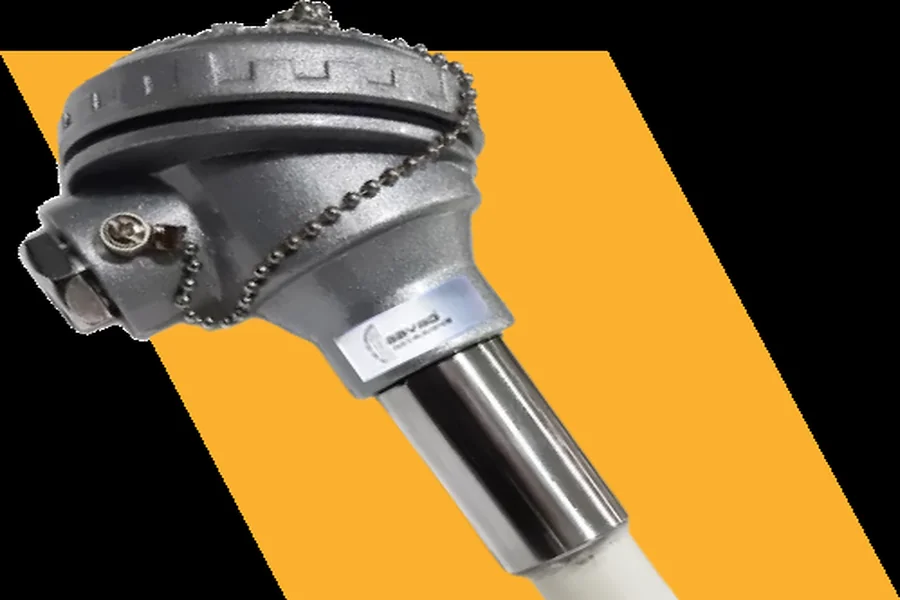
Thermocouples are probably the most common sensor you’ll find on an industrial site. Engineers build them for furnaces, kilns, heat treatment lines, reactors, boilers, and exhaust systems, basically anywhere things get seriously hot.
Different thermocouple types work for different temperature bands and atmospheres. Noble-metal types like R, S, and B, for instance, are the go-to choice for high-temperature work. Protection tubes and thermowells can also be used where the sensing element needs protection from mechanical or chemical conditions.
A practical point often missed during selection is that the sensor element isn’t working alone. Sheath material, protection tube, installation depth, process atmosphere, and response time can all affect the final reading.
2. RTDs for Stable and Accurate Measurement
When accuracy, repeatability, and steady readings really matter, RTDs are usually the pick. You’ll see them on tanks, pipelines, HVAC systems, process equipment, machinery, and general plant monitoring.
Their big selling point is a predictable resistance-to-temperature relationship. But installation still counts for a lot. Put an RTD in a poor spot, and it might end up reading the surrounding surface or a stagnant pocket of air instead of the actual process temperature you care about.
Response time deserves a second look too. A heavy, bulky protective assembly can be slow to react to fast temperature swings. In a process where temperature jumps around a lot, that lag can throw off your control performance. Tempsens’ own technical material flags time constant as a real factor in how responsive an RTD ends up being.
3. Infrared Pyrometers for Non-Contact Measurement
Sometimes touching the target isn’t an option, and that’s where pyrometers are useful. They work well on moving materials, hot surfaces, rotating parts, molten metal, and anywhere a probe would just get in the way of production.
They are particularly useful in high-temperature industrial environments. However, the optical path must remain suitable, and emissivity must be considered during setup.
For difficult surfaces, specialised pyrometers can provide a better solution than a basic single-wavelength instrument. Aluminium is a good example; its emissivity shifts around enough to trip up conventional infrared measurement, so a specialised pyrometer usually does a better job there.
4. Online Thermal Imagers for Temperature Mapping
A thermal imager gives you a lot more than a single-point sensor ever could. It shows temperature spread across a whole piece of equipment and helps flag hot spots you wouldn’t otherwise notice.
That’s useful for things like electrical equipment inspection, furnace checks, process monitoring, and general condition assessment. Instead of checking one spot at a time, your team can scan a wider area and compare patterns across it.
That kind of view can save real time when you’re troubleshooting.
5. Temperature Gauges and Transmitters
A temperature gauge gives operators a direct, local reading, handy when they need a quick check without pulling up a control system screen.
Transmitters do a different job. They take the sensor signal and convert it into something a monitoring or control system can actually use. Wireless transmitters help a lot in spots where running signal wiring would be difficult or just too costly. Plenty of industrial wireless temperature transmitters on the market today handle both RTD and thermocouple inputs, built for exactly those hard-to-wire applications.
6. Specialised Sensors for Difficult Applications
Not every temperature problem on a plant floor fits a standard probe. Harsh conditions sometimes call for thermowells, mineral-insulated assemblies, fibre-optic sensors, special protection tubes, or a sensor built for that specific job.
The important point is that measurement accuracy starts with application fit. A technically accurate sensor can still provide poor process data if it’s installed in the wrong location or exposed to conditions outside its intended design.
How to Choose a Temperature Measurement Technique?
Start with the process, not the product.
First, define the temperature range. A sensor suitable for 600°C may be inappropriate for a process approaching 1,500°C. Next, determine whether the measurement should be contact or non-contact.
Then consider:
- Required accuracy and repeatability
- Response time
- Process pressure
- Chemical exposure and atmosphere
- Material and surface emissivity
- Sensor installation depth and location
- Mechanical vibration or movement
- Electrical interference
- Maintenance access
- Calibration requirements
- Signal transmission and control-system compatibility
For example, a stationary liquid inside a tank may be well suited to an RTD, while a moving hot steel product may be better measured with a non-contact pyrometer. A furnace with multiple temperature zones may require several thermocouples or a combination of contact sensors and thermal imaging.
Calibration shouldn’t be treated as an afterthought. Traceability to recognised standards helps ensure that the temperature reading has a defensible measurement basis.
Final Words
There’s no single universal technique that covers every industrial process out there. The right pick comes down to matching the sensing principle to your process, your environment, your accuracy needs, and how much maintenance you’re willing to put in. Tempsens offers temperature sensing solutions across the board: thermocouples, RTDs, thermowells, infrared pyrometers, thermal imagers, temperature transmitters, and calibration services for industrial use.
With the right measurement approach, plants can get more reliable process data, respond to temperature changes sooner, and maintain tighter control over product quality and equipment performance. The goal isn’t simply to measure temperature, but to make sure the reading is dependable enough to support the decisions made on the plant floor.