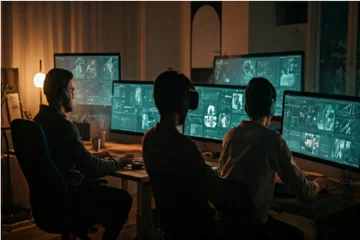

What is physical AI and why is it becoming the next breakthrough in artificial intelligence? As AI moves beyond software into real-world environments, businesses are exploring how to connect models with machines and infrastructure. At FPT AI Factory, organizations can build and scale Physical AI systems with powerful GPU infrastructure and deployment platforms.
1. AI is moving beyond screens into the real world
Traditionally, artificial intelligence has been used in digital systems like chatbots, recommendation engines, and data analytics, where it mainly processes information without interacting with the physical world. Now, AI is evolving into a new stage called Physical AI, where it can perceive environments, make decisions, and act within dynamic environments, transforming it from a passive system into an active technology that operates in physical spaces.
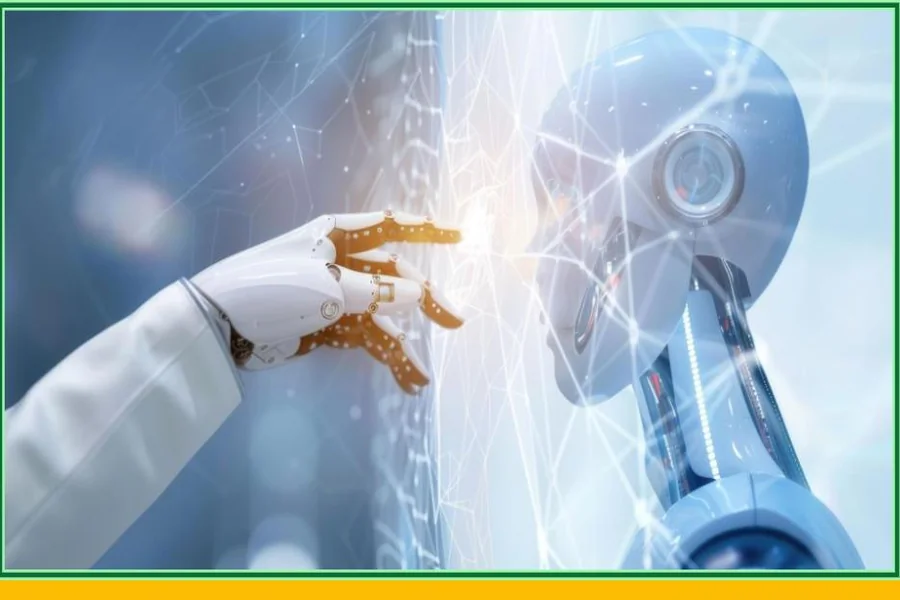
AI is evolving into Physical AI that acts in the real world.
2. How Is Physical AI Used in Real-World Applications?
To understand what is Physical AI, it is important to see how it works in practice. Physical AI combines AI models with sensors, machines, and control systems to interact directly with the physical world, rather than operating only in software environments. Unlike traditional automation, it enables systems to sense, decide, and act in real time through a continuous cycle of sensing, thinking, and acting, allowing them to adapt to changing conditions.
In real-world applications, Physical AI is used in areas such as warehouse robotics, defect detection in manufacturing, self-driving and traffic systems, as well as intelligent infrastructure like energy management and surveillance systems. Physical AI also needs to operate with greater autonomy and improved coordination across devices and environments.
- In manufacturing, Physical AI improves quality control and production efficiency. AI-powered systems can detect defects, predict machine failures, and optimize production lines in real time.
- In logistics, Physical AI enables smarter warehouses and delivery systems. Autonomous robots handle goods, while AI optimizes routes and inventory management to improve efficiency.
- In healthcare, Physical AI supports robotic-assisted surgery, real-time patient monitoring, and advanced diagnostic systems, improving both accuracy and speed.
- In transportation, Physical AI enhances safety and mobility. Autonomous vehicles and intelligent traffic systems help reduce congestion and improve travel efficiency.
3. Key components behind Physical AI
Physical AI combines multiple technologies that work together to enable real-world interaction. These components help systems perceive their environment, process data with low latency, and act efficiently in physical settings, forming the backbone of reliable and scalable deployments.
3.1. Computer vision
Computer vision enables machines to interpret visual data from images and video streams. In Physical AI, it supports object detection, motion tracking, and environment understanding, allowing systems to “see” and respond more accurately in real-world scenarios.
3.2. Edge computing
Edge computing ensures fast, real-time decision-making by processing data closer to where it is generated. Instead of relying solely on centralized systems, it reduces latency and improves responsiveness, which is essential for time-sensitive Physical AI applications.
3.3. Robotics systems
Robotics acts as the physical layer that connects AI with the real world. With AI integration, robots can move beyond fixed instructions, learning from data, adapting to environments, and performing more complex and dynamic tasks.
3.4. GPU infrastructure
Physical AI requires high computing power to handle real-time workloads. GPU infrastructure supports model training, real-time inference, and large-scale sensor data processing, making it essential for performance and scalability.
Physical AI enhances healthcare with smarter surgery, monitoring, and diagnosis
4. Why is infrastructure the biggest challenge for Physical AI?
Despite its potential, Physical AI is limited by infrastructure challenges, as real-world deployment requires high levels of speed, precision, and reliability.
- World modeling complexity:
Physical AI requires accurate representations of real-world environments, which are far more complex and dynamic than digital data. This depends on large, continuously updated datasets collected from sensors and real-world operations. - Edge deployment:
Many Physical AI systems need to process data close to where it is generated to reduce latency and improve responsiveness. However, deploying AI at the edge introduces challenges in system architecture, hardware limitations, and distributed management. - Cost constraints:
Developing and deploying Physical AI systems requires significant investment in computing resources, infrastructure, and integration. Costs extend beyond initial setup to include ongoing operations, scaling, and maintenance. As a result, organizations must carefully balance performance needs with long-term cost efficiency. - Safety and reliability requirements:
Because Physical AI operates in real-world environments, errors can lead to direct physical consequences. This requires strict control systems, continuous monitoring, and robust validation processes.
5. What’s next for Physical AI?
Physical AI is rapidly moving from experimental use cases to large-scale deployment. In the future, systems will become more intelligent, more connected, and more capable of operating autonomously in complex environments. Key trends include:
- Expansion from pilot projects to enterprise-scale adoption
- More advanced embodied intelligence in machines and robots
- Better coordination between devices, models, and infrastructure
- Stronger focus on safety, transparency, and control
- Increased value creation in industries through automation and optimization
Physical AI extends artificial intelligence beyond digital systems into the physical world, enabling machines to perceive, decide, and act in real time. This creates new opportunities for automation, efficiency, and innovation across industries. With FPT AI Factory, businesses can explore and scale Physical AI through the infrastructure needed to support real-world applications. Reach out to FPT AI Factory today for a personalized consultation to optimize your deployments!
Starter Plan – Free $100 to get started
- $100 in credits for new users to explore FPT AI Factory for 30 days.
- $10 for GPU Container, $10 GPU Virtual Machine, $10 AI Notebook, and $70 for AI Inference & AI Studio.
- Your card is encrypted. $1 verification charge will be added to your balance.
- Up to 5M tokens with Llama-3.3 & 20+ models.
Contact Information:
- Hotline: 1900 638 399
- Email: support@fptcloud.com