

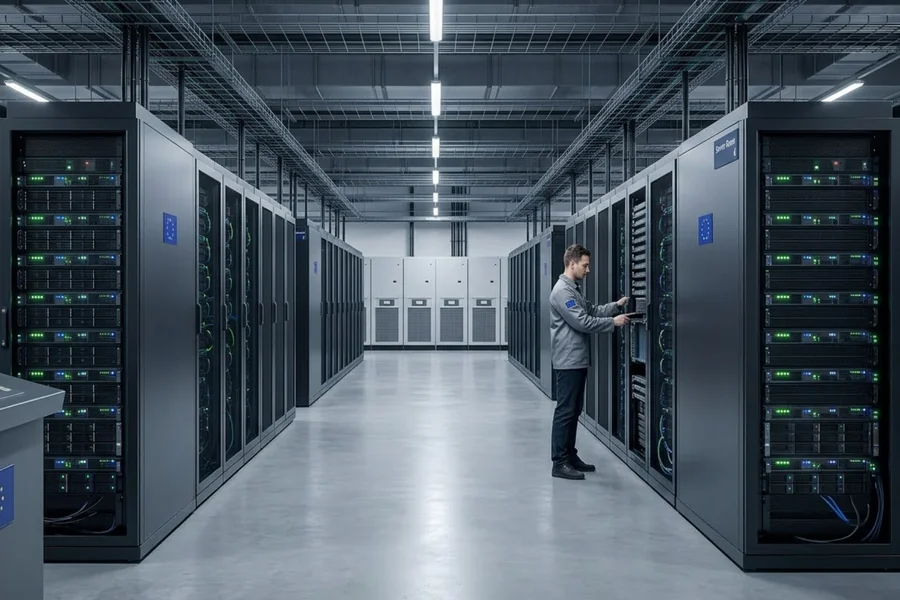
Infrastructure risk today does not knock on the door; it breaks it down entirely. Energy instability, sophisticated cyberattacks, and physical threats reinforce each other, creating scenarios that traditional IT security can no longer handle. Secure colocation in a professional data center offers multilayer protection, from backup power sources and network redundancy to data center security. Read on to learn how to systematically eliminate weak points.
Global data center capacity is growing at an annual rate exceeding 14%, and total investments in the sector are expected to reach up to $3 trillion by 2030, according to JLL. However, as dependence on digital infrastructure increases, so do the risks, and these are no longer limited to cyberspace alone. To manage these risks effectively, companies need a strategy that covers all layers of protection simultaneously.
Secure Colocation and the Dual Nature of Infrastructure Risk
When we talk about a resilient IT infrastructure, most managers think of firewalls, encryption, and antivirus systems. However, cyber and physical security are two sides of the same coin, and neglecting one undermines investments in the other.
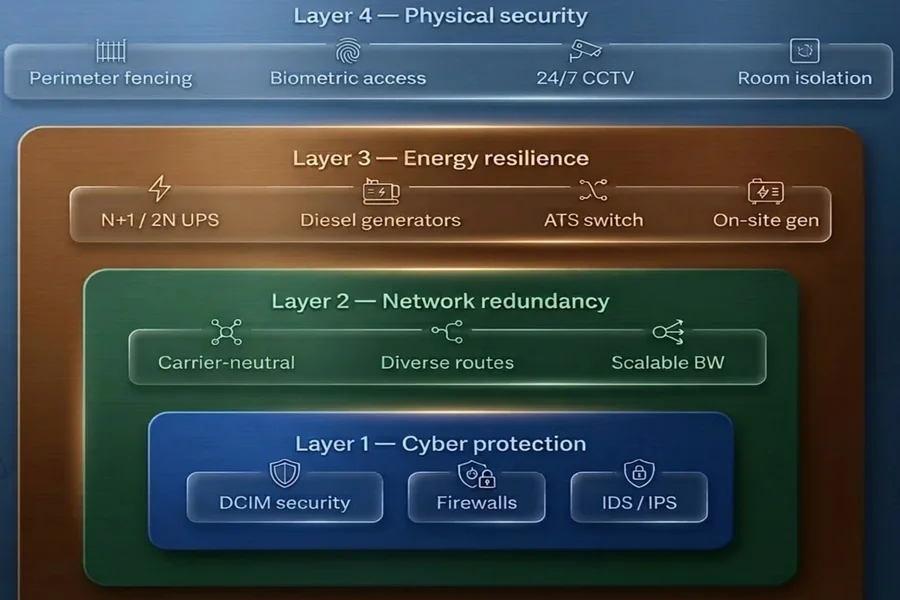
Cyber threats today include ransomware attacks, supply chain compromises, or infiltration of data center infrastructure management (DCIM) platforms. Attackers increasingly target not only data but also operational technologies. By manipulating cooling or power systems, they can shut down entire server halls. On the other side are physical risks such as natural disasters, fires, infrastructure failures, or simple human error during unauthorized access.
Professional secure colocation addresses both categories simultaneously, from network segmentation and multi-level access control to redundant power supply and cooling. It is this interconnected approach that distinguishes a truly resilient IT infrastructure from a mere collection of isolated security measures.
Energy Resilience—The Backbone of Secure Colocation
According to IDC, global data center electricity consumption is expected to grow at a CAGR of 19.5% and reach 857 TWh by 2028. Energy availability is therefore becoming one of the most critical factors in operations and, at the same time, one of the greatest vulnerabilities.
Modern data centers build energy resilience on the principles of redundancy:
- N+1: the system includes one additional backup component beyond the minimum required for operation.
- 2N: full duplication of the entire power path, including UPS units and distribution systems.
- Diesel generators: ensure uninterrupted operation even during prolonged power outages.
- On-site energy generation: some data centers operate their own energy production, for example, through trigeneration combining electricity, heat, and cooling.
Surge protection, automatic transfer switching between power sources (ATS), and continuous energy network monitoring add further layers to this system. The result is an environment where the failure of a single component does not mean service failure.
Tip: An example of a carrier-neutral data center with a focus on energy efficiency (PUE ~1.34) and a transparent business model is Prague-based ttc-teleport.cz/en/.
Network Resilience—Why Secure Colocation Relies on the Carrier-Neutral Principle
A single operator in a building means a single point of failure, and that is a risk no company running critical applications can afford today. A carrier-neutral data center enables connections to multiple telecommunications providers at the same time, eliminating dependence on a single connectivity provider.
The practical impact of this approach goes beyond availability:
- route diversification: operations continue even if one provider fails or a physical route is disrupted
- competitive environment: multiple operators under one roof drive prices down and quality up
- scalability: companies can increase bandwidth without changing data centers or negotiating exclusive contracts
Data center security therefore depends not only on what is inside but also on how many independent paths data can take in and out.
Physical Security and Geographic Diversification
Even the best firewall will not protect a server that an attacker can physically access. That is why professional data centers layer physical protection across multiple levels, from perimeter fencing and biometric access control to continuous CCTV monitoring and segmentation of individual halls, where each client operates in a separate, isolated space.
Segmentation as a Principle, Not an Add-On
Separating customer environments prevents an incident affecting one client from impacting others. The combination of fire suppression systems, independent cooling circuits, and separate power distribution in each hall creates autonomous operational units, where the failure of one does not endanger the rest.
Geographic Location and Regulatory Context
Choosing a location goes beyond latency considerations. Data centers within the European Union are subject to strict regulatory frameworks such as GDPR, NIS2, and DORA, ensuring a high standard of data protection. A Central European location, for example in the Czech Republic, also offers low exposure to natural disasters, a stable energy grid, and strategic proximity to both Western and Eastern European markets. For companies building a resilient IT infrastructure, geographic diversification is just as important as technical redundancy.
Risk Won’t Wait, Preparedness Will
Infrastructure risk will not wait for a company to decide to act, and its impacts do not respect the boundaries between the cyber and physical worlds. Organizations that invest in professional secure colocation with multilayer protection are not only addressing today’s threats but also building a foundation on which their business can grow, even when the rules of the game change again.
Data sources:
- https://www.jll.com/en-us/insights/market-outlook/data-center-outlook
- https://my.idc.com/getdoc.jsp?containerId=prUS52611224