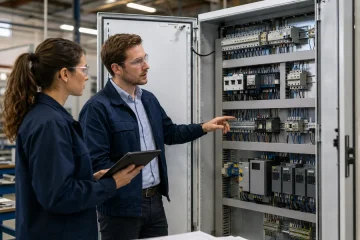

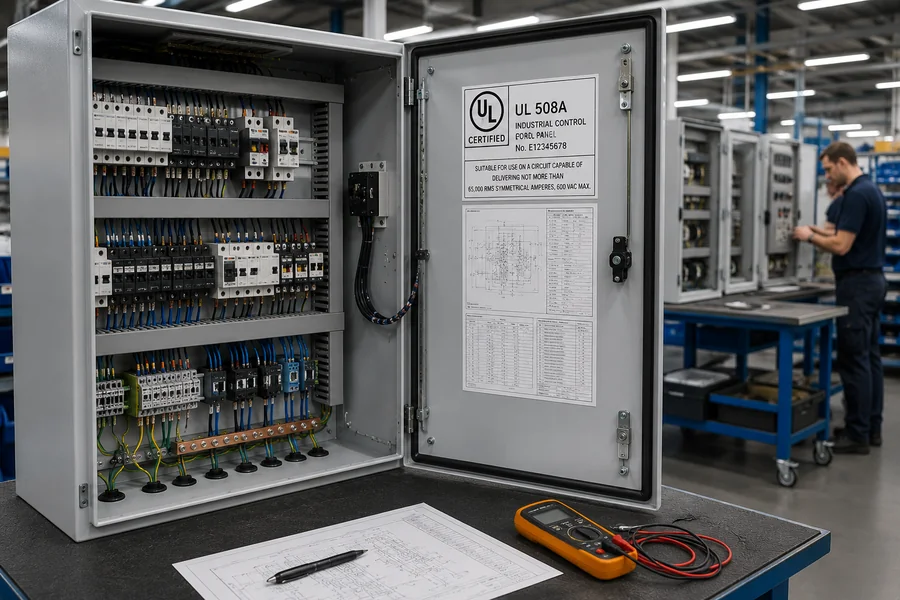
Over 70 years of accumulated expertise in electrical panel manufacturing shapes every step of the UL specification process. UL certification is not a label applied at the end of production — it governs how a panel is designed, wired, tested, and documented from the first decision point. For engineers choosing between UL 508A and UL 891, understanding the technical differences around UL panels is where the specification process begins.
- UL 508A and UL 891 are not interchangeable – standard selection depends on whether the panel controls machinery or distributes power.
- Both US and Canadian market requirements can be met through separate certifications, which affects documentation and labelling from the outset.
- Working with a dual-certified manufacturer that handles design, build, documentation, and labelling in-house removes several coordination steps from the engineer’s specification process.
UL 508A vs. UL 891 – Choosing the Right Standard
UL 508A governs industrial control panels — wiring clearances, component placement, safety testing, and labelling. UL 891 applies to low-voltage switchboards and distribution panels up to 600 V. If the panel controls machinery or automates a process, UL 508A applies. If it distributes power to a building or facility, UL 891 applies.
Engineers who confuse the two early on risk misaligned designs, failed safety testing, or unnecessary rework. Projects requiring both standards must plan for them from the start.
Wiring Clearance and Component Placement Under UL 508A
UL 508A imposes strict requirements on wiring clearance and component placement to prevent electrical faults. These are compliance requirements, not design preferences. Engineers must account for minimum distances between live conductors, grounded surfaces, and components with different potentials, as well as mounting and spacing rules for heat dissipation and maintenance access.
Retrofitting a non-compliant design to meet UL 508A typically forces redesign and retesting. Certification requires the panel is built to pass from the ground up.
Electrical Safety Testing and What It Requires
Under both standards, electrical safety testing is built into the manufacturing process. UL 508A testing covers insulation resistance, dielectric strength, and thermal performance. UL 891 testing focuses on switchboard integrity, fault current ratings, and protection coordination.
Labelling and documentation are part of compliance, not administrative add-ons. Every UL-certified panel must carry permanent labelling identifying the standard, rated voltage and current, and manufacturer — and documentation must trace the panel’s full design, build, and test history.
US vs. Canadian Market Requirements
UL certification for the US and Canadian markets are separate. A panel certified to UL 508A for the US will not automatically meet Canadian requirements. The same applies to UL 891.
Engineers on cross-border projects need a manufacturer that handles certification for each market independently. SystemTeknik’s dual certification for both US and Canadian markets removes the ambiguity from this part of the specification process.
What In-House Certification Capability Changes for Engineers?
When a manufacturer handles design, build, documentation, and labelling in-house, there are fewer handoff steps, fewer points of miscommunication, and a single point of accountability for compliance. Engineers don’t have to coordinate between a designer, builder, documentation specialist, and third-party labeller.
Systemteknik.com offers a full-lifecycle service model — from consulting and design through production, commissioning, and service — which is what makes dual certification practical. Their service department can install, commission, and maintain panels after delivery, closing the loop on the project lifecycle.
Which Standard Fits Which Project?
Use UL 508A for control panels managing machinery, automation, or process control. Use UL 891 for switchboards and distribution panels handling power distribution up to 600 V. Resolve the standard question at the start — engineers who do, and work with a manufacturer certified for both standards and both markets, avoid the most common compliance bottlenecks before production begins.