
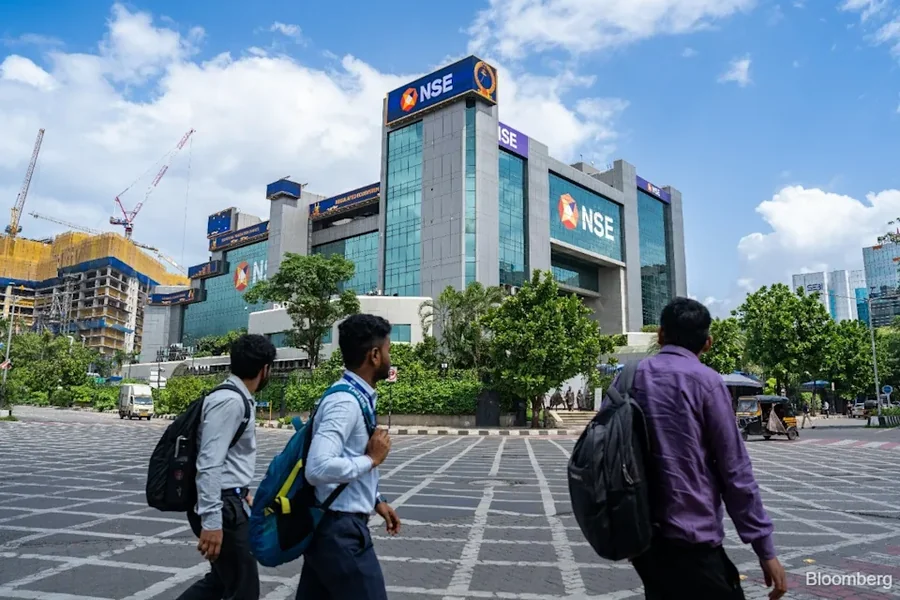
The National Stock Exchange (NSE) is one of the most valuable listed companies in India, but it is not in the same league as India’s top stocks such as Reliance Industries, HDFC Bank, TCS and Bharti Airtel. These stocks operate in energy, banking, technology and the telecoms sector, while NSE is a market infrastructure company whose profits are driven by transaction charges, trading volume and listings.
In this blog, we will compare NSE with India’s biggest stocks across several parameters.
Where does NSE stand in terms of market capitalisation?
Market capitalisation, not just the NSE share price, is the simplest starting point for comparing NSE with India’s biggest listed companies. While NSE has emerged as a major listed company after its IPO, it remains smaller than India’s most valuable conglomerates, banks, and telecom majors. The comparison below puts this scale in perspective:
| Company | Market capitalisation
(As of November 9, 2026) |
Core business |
| Reliance Industries | ₹17.92 lakh crore | Energy, retail, telecom and digital services |
| Bharti Airtel | ₹12.93 lakh crore | Telecom and digital infrastructure |
| HDFC Bank | ₹12.30 lakh crore | Banking and financial services |
| TCS | ₹8.96 lakh crore | IT services |
| NSE | ₹4.8 lakh crore | Stock exchange and market infrastructure |
What drives NSE’s earnings
NSE is highly profitable. In FY26, it reported a consolidated total income of ₹18,713 crore, profit after tax of ₹10,302 crore, and a Return on equity of 33%. However, its revenue is tightly coupled with market participation.
NSE generates revenue through transaction charges as it offers other companies the infrastructure to facilitate trading of their shares. Its business is therefore highly scalable but also sensitive to market cycles. This is a significant difference from India’s biggest stocks.
How it stacks up with large caps
The large-cap leaders in India tend to have a diversified revenue mix and often operate on an enormous scale. Reliance has multiple business segments, including refining, petrochemicals, organised retail, and digital services; HDFC Bank relies on lending, deposits, and fee income; TCS earns from IT outsourcing to the world; and Bharti Airtel earns from recurring telecom subscriptions.
The strength of NSE is its commanding market share in the cash equity and derivatives markets in India. It represented about 93% of the cash-market turnover, almost 100% of the equity-futures turnover and 75% of the equity-options premium turnover in FY26. But its market capitalisation is about 27% of Reliance’s and less than half of HDFC Bank’s.
It is therefore a significant large-cap stock, but it still has a long way to go to be a company in the same valuation league as India’s biggest conglomerates and financial institutions.
Valuation and risk
Investors are interested not only in NSE’s size but also in the sustainability of its earnings. It has high margins and a commanding market share, but regulatory oversight, competition from other exchanges and the rules governing the derivatives market can also affect its future profitability.
India’s large cap stocks are not without risks, but many of them have more diversified revenue streams. For instance, the credit cycles and deposit costs are the key drivers of the fortunes of HDFC Bank, whereas energy prices, retail execution and telecom competition are the key drivers of the fortunes of Reliance. Hence, NSE’s risk profile is more concentrated, though its business model remains structurally attractive.
Wrap up
NSE is no longer just a trading platform for India; it is now a major listed company on BSE. It has a market capitalisation of ₹4.8 lakh crore and is among the large caps of India. From a long-term investor’s perspective, NSE can be considered a high-margin bet on India’s financialisation.
But the investment decision between NSE and other big stocks of the Indian financial markets should be based on whether the investor wants to have concentrated exposure to financial market activity or diversified exposure to the corporate economy of India.