

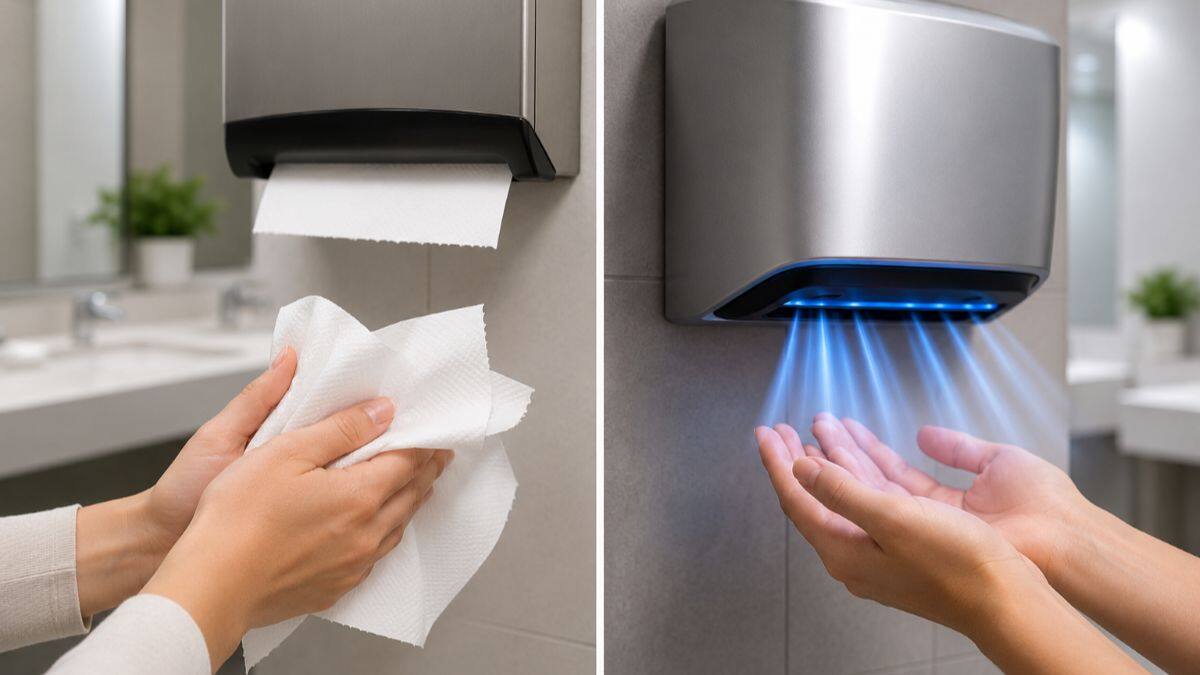
At first, this feels like a simple choice. Paper towels or a hand dryer.
One is easy to install, the other needs a bit of setup. That’s usually how the decision starts.
But once the washroom is actually in use, the question changes. It’s not just what works. It’s what keeps working without needing constant attention.
Where the Cost Actually Shows Up
Most people look at the starting cost. Paper towels seem lighter on the budget. No wiring, no installation, nothing complicated.
A hand dryer feels like a bigger decision upfront. That part is true.
But that’s only the first layer. The real cost doesn’t show up on day one. It shows up after a few weeks of usage.
The Paper Towel Cycle (It Doesn’t Really Stop)
In a busy washroom, paper towels move fast. Faster than expected, actually.
They need to be refilled again and again. And then there’s the waste. Bins fill up, sometimes quicker than planned.
Someone has to keep checking all of this. And if that doesn’t happen on time, it’s immediately visible.
You walk in and either there’s no paper, or the bin is overflowing.
So the cost here isn’t just the product. It’s the effort around it.
What Changes With a Hand Dryer
A hand dryer removes that cycle almost completely.
Once it’s installed, there’s nothing to refill. No bins to manage. It just keeps running.
The only ongoing cost is electricity, and that tends to stay predictable.
In places where usage is high, that difference starts becoming noticeable fairly quickly.
When Usage Increases, the Gap Widens
In smaller spaces, both options can work without much difference.
But in places like malls, airports, or large office buildings, things behave differently.
More users mean more paper consumption. More refilling. More cleaning.
A hand dryer doesn’t scale in the same way. It handles more usage without needing extra effort.
That’s where the gap really starts to show.
Maintenance Feels Different in Reality
Paper towels need visible maintenance. Someone has to keep checking them.
If that routine slips, even for a short time, the problem shows up immediately.
A hand dryer is different. It still needs cleaning, but not throughout the day.
It doesn’t depend on someone constantly monitoring it.
Consistency Is Where It Gets Interesting
This part is often overlooked.
Paper towels depend on timing. If refilling is delayed, the system breaks for the user.
A hand dryer doesn’t have that issue. It’s either working or it’s not. And when it’s working, it stays consistent.
In high-traffic spaces, that consistency matters more than expected.
The Hidden Side of Cost
There’s also the indirect side.
Paper towels create waste. That means handling, disposal, and cleaning around that area.
It may not feel like a direct cost at first, but over time, it adds to the workload.
A hand dryer avoids that part completely. No waste, no extra handling.
Quick Comparison
| Factor | Paper Towels | Hand Dryer |
| Starting Cost | Lower | Higher |
| Ongoing Cost | Continuous | More stable |
| Maintenance | Frequent checks | Occasional |
| Waste | High | Minimal |
| Reliability | Depends on refill timing | Consistent |
So, Which One Makes More Sense?
It really depends on how the space is used.
If the washroom sees limited usage, paper towels can still work without much trouble.
But once usage increases, the system starts demanding more attention.
That’s where a hand dryer becomes easier to manage over time. Not because it’s cheaper on day one, but because it stays consistent.
Final Thoughts
The choice between paper towels and a hand dryer isn’t just about price. It’s about how the system behaves every day.
Paper towels are simple to start with, but they come with a continuous cycle.
A hand dryer needs a bit more setup, but once it’s running, it stays predictable.
And in busy commercial spaces, predictability often turns out to be the bigger advantage.