

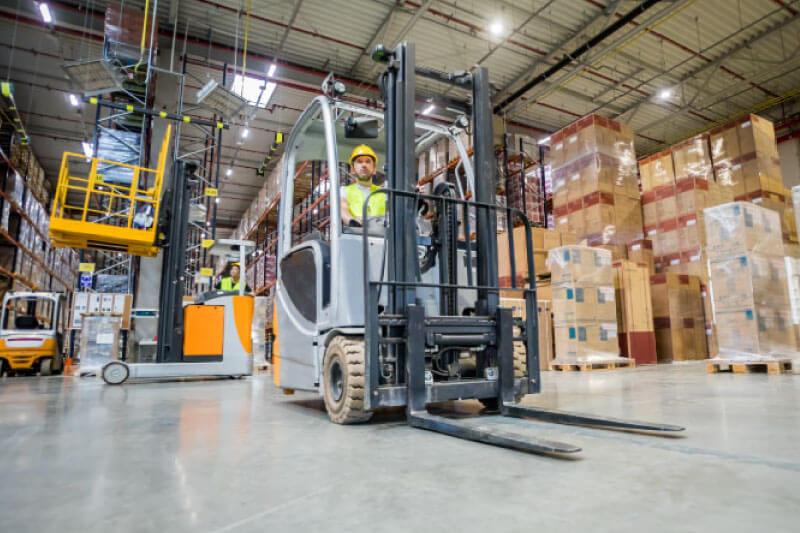
Floor markings, mirrors, and warning sirens help organize vehicle movement, but they cannot respond to changing traffic. At peak throughput, these passive controls leave teams exposed to blind spots and human error.
A forklift rarely operates in isolation when people and vehicles share the floor. A forklift collision avoidance system can use connected tracking data to identify moving equipment and workers, alert drivers to nearby traffic, and reduce contact with vehicles, assets, and pedestrians.
The real advantage is operational context: where a forklift is moving, which hazards surround it, and who is in its path.
Why Predictive Awareness Matters
Conventional systems react only after risk crosses a set threshold. The result is often abrupt stops, dropped loads, and repeated warnings that operators begin to ignore. Predictive awareness provides earlier, more relevant intervention.
Proximity Sensors Are Not Enough!
A forklift entering an aisle may have no view beyond the next rack or corner. A vehicle approaching from the other side can remain hidden until both are close to the same point. Sensors limited to the immediate area cannot account for that wider movement.
What Blind Spots Cost the Operation
Limited vehicle visibility affects more than accident costs. When operators must honk, pause, and creep through blind intersections, small delays accumulate across shifts and reduce distribution-center throughput.
Poor Floor Visibility Distorts Fleet Needs
Poor spatial visibility also weakens equipment management. If supervisors cannot locate parked vehicles, teams lose time searching for available units and may approve unnecessary purchases to solve what is fundamentally a visibility problem.
Turning Location Data into Active Safety
Live positioning gives safety systems a current view of activity in high-risk areas. Facilities can apply additional controls where forklift and pedestrian traffic converge, including automatic speed enforcement when a vehicle exceeds the local limit.
Not Constant, rather Contextual Alerts
Disconnected dashboards can report conflicting signals and overwhelm operations teams. Integrating location data with safety protocols creates one operational view, showing not only that a near miss occurred but also why it happened and which layout or process changes could prevent a repeat.
Build Beyond Closed Sensor Systems
Closed hardware ecosystems can lock facilities into one vendor and restrict future upgrades. Interoperable data layers give teams more flexibility to connect emerging technologies directly to their safety models.
High-fidelity forklift tracking provides the shared visibility needed to replace isolated point solutions with coordinated safety decisions.
Designing for Measurable Operational Outcomes
LocaXion integrates RTLS and digital twin systems around defined business outcomes rather than tracking alone.
A technology-agnostic approach reduces integration risk, speeds deployment, and lets facilities scale with the systems that best fit their operating requirements.
The goal is a safer, more visible operation in which tracking data supports timely decisions and measurable performance.
Explore how to reduce blind spots and improve operational control at https://locaxion.com/