

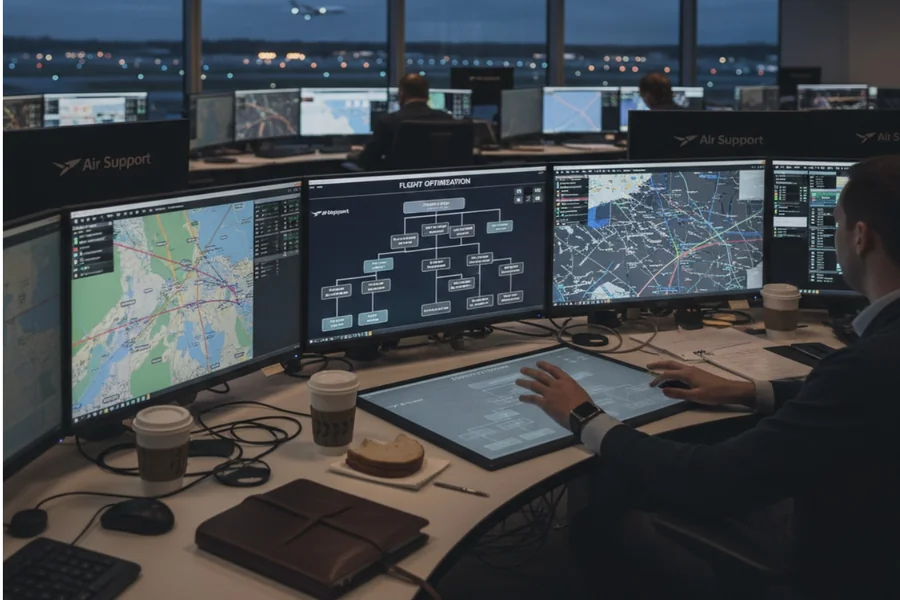
Commercial aviation is under intense pressure. Airlines must keep costs under control, reduce emissions, deliver a better passenger experience and still remain flexible in a market where routes, regulations and customer expectations shift rapidly. In that environment, the quiet revolution does not sit in the cabin or on the runway, but in the digital backbone that plans, monitors and supports every single flight.
Flight support has moved far beyond paper charts and phone calls between dispatch and crew. Today, the most competitive operators rely on integrated platforms that merge data from aircraft sensors, weather services, airport systems and maintenance tools into a single operational picture. That shift is turning flight operations from a reactive discipline into a predictive one.
From paperwork to predictive operations
For decades, dispatchers and pilots worked with static information. Flight plans were printed, weather charts were updated a few times a day, and any disruption triggered a chain of manual calls and approvals. The system worked, but it left little room for optimisation. Fuel was often over‑planned as a safety buffer, crews had limited visibility into real‑time conditions, and small delays easily cascaded across a network.
Digitalisation changed the baseline. Modern flight support platforms ingest live meteorological feeds, traffic flow restrictions, NOTAMs, airport capacity data and aircraft performance information. They generate optimised flight plans in minutes, not hours, and they keep refining those plans as conditions evolve, even while the aircraft is in the air.
This is where solutions such as Air Support illustrate how deeply software now shapes everyday aviation. Instead of treating flight planning, briefing and in‑flight monitoring as separate steps, they are tied together in a continuous loop of data. Dispatchers adjust routing based on new jet stream data, pilots receive updated briefings on their tablets, and operations control immediately sees the impact on arrival times and turnarounds.
Why integrated flight support matters
The impact of this integration shows up in several concrete areas that matter to both airlines and passengers.
First, there is efficiency. Fuel remains one of the largest cost drivers in aviation. Even small route optimisations or altitude changes can save hundreds of kilograms of fuel on a long‑haul flight. When planning tools evaluate thousands of route permutations against live winds, airspace restrictions and aircraft performance, they uncover savings that manual methods miss. Over a year, those incremental gains translate into millions in reduced fuel burn and lower emissions.
Second, safety margins improve. Real‑time information about turbulence, volcanic ash, convective weather and runway conditions allows crews and dispatchers to make decisions based on the latest data rather than outdated forecasts. Automated alerts flag emerging risks before they escalate, while standardised digital briefings reduce the chance of misunderstandings between ground and cockpit.
Third, disruption management becomes more agile. When a storm closes a hub, or an aircraft goes out of service unexpectedly, integrated systems help operations teams re‑plan crew rosters, aircraft rotations and passenger connections in a coordinated way. Instead of juggling spreadsheets and phone calls deep into the night, dispatchers work from a shared operational picture that updates as new decisions are made.
The cockpit goes fully digital
On the flight deck, the shift is just as visible. Electronic flight bags on tablets have replaced binders of paper manuals and charts. Pilots receive their flight plans, weather briefings and performance calculations digitally, and they update them with a few taps. The cockpit becomes a node in a connected network, not an isolated end point.
This connectivity supports a more collaborative decision‑making culture. A dispatcher might recommend a route change to avoid building thunderstorms, while a pilot, looking at live radar and ride reports, suggests a slightly different track. The system reconciles these inputs, recalculates fuel, and shares the outcome with maintenance and ground handling so they can prepare for any schedule change.
In regions with challenging weather or limited alternate airports, such as parts of Scandinavia, this digital backbone proves particularly valuable. Operators flying to and from smaller airports gain access to the same level of situational awareness as large legacy carriers, which raises the overall bar for safety and reliability across the network.
Data, automation and the next step
The next wave of flight support is built on deeper data use and smarter automation. Every flight generates a rich stream of information: actual fuel burn, climb performance, route choices, delay patterns and more. When this data is stored and analysed, it reveals patterns that help fine‑tune future planning.
For example, if analysis shows that a certain route segment consistently suffers from headwinds stronger than the forecast models suggest, planning rules can be adjusted to reflect reality. If a specific aircraft tail number shows slightly degraded climb performance, maintenance can intervene before it triggers operational constraints.
Automation does not replace human decision‑makers; it augments them. Algorithms handle repetitive tasks such as recalculating fuel after a minor route change or checking compliance with complex airspace rules. Dispatchers and pilots focus on judgement calls: when to divert, when to hold, how to balance passenger connections with crew duty limits, and how to communicate changes clearly.
Cybersecurity and resilience also move higher on the agenda. As more critical functions depend on connected platforms, operators must design for redundancy, robust backup procedures and secure data flows. The most forward‑looking flight support providers build their tools with failover options, offline capabilities and strict access controls to ensure continuity even during outages.
A quieter revolution above the clouds
For passengers, most of this transformation remains invisible. They notice smoother flights, fewer last‑minute cancellations and more accurate arrival predictions on their phones, but they rarely think about the software and teams working behind the scenes. Yet the competitive gap between airlines that embrace modern flight support and those that cling to legacy processes continues to widen.
As regulators push for greener operations, airports demand better punctuality and travellers expect real‑time information, the strategic value of advanced flight support grows. What once was seen as a back‑office function now sits close to the core of an airline’s digital strategy.
The skies will not suddenly fill with futuristic aircraft, but they will become steadily smarter. Each new layer of data, each incremental improvement in planning and coordination, nudges aviation toward operations that are safer, leaner and more predictable. In that sense, the real innovation is not a single piece of hardware or a headline‑grabbing gadget, but the quiet, constant refinement of how every flight is prepared, flown and supported from the ground.