

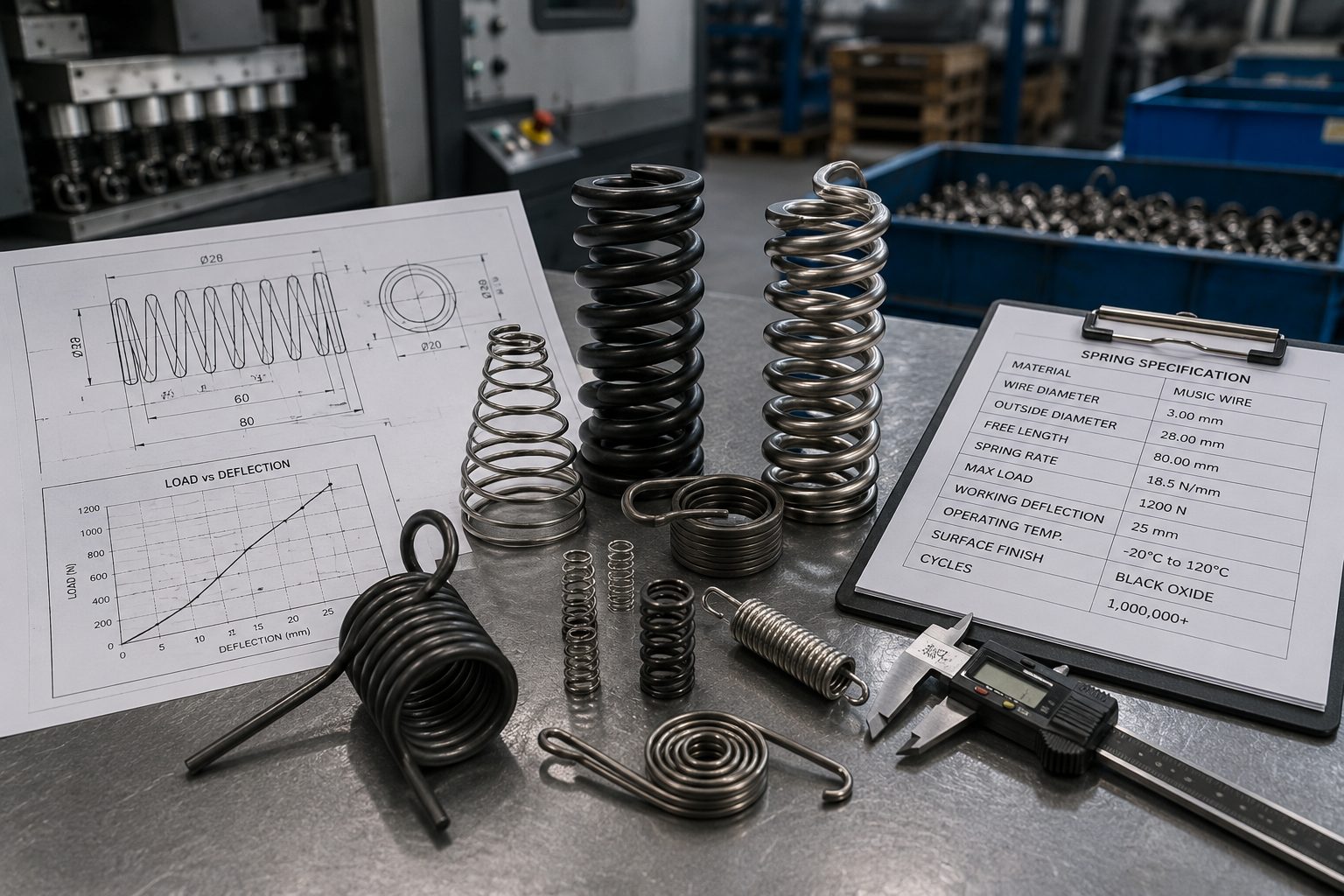
A single spring cut to the wrong dimension can bring a production line to a halt for hours. Not because it fails catastrophically, but because it slowly drifts out of tolerance until a machine misfires. Many companies choose off-the-shelf components to save time on procurement, only to face more frequent replacements down the line. Custom springs solve this problem at the source by matching the component to the actual load, cycle count, and environment it operates in. In practice, the failure rarely shows up on the production floor first. It shows up in the maintenance log, weeks before anyone connects the dots.
Why standard springs let industrial equipment down
Standard springs are manufactured for general-purpose use. They cover a wide range of applications reasonably well, but they are not engineered for a specific machine’s load pattern, operating temperature, or cycle frequency. That gap creates a hidden cost. A standard spring may fit the housing perfectly and still fatigue twice as fast under a load profile it was never designed for.
The purchase price looks lower on the invoice, but the equipment then needs more frequent maintenance stops, more spare parts on the shelf, and more technician hours spent tracking down a failure that keeps recurring. Custom springs cost more upfront because they account for the actual stress the part will face, not an average case. A batch rated for 1,000,000 cycles at room temperature can lose a large share of that lifespan once the operating temperature climbs past 80°C. That’s exactly the kind of detail a general catalogue spec never mentions.
What makes a spring truly custom
Wire thickness, material grade, coil diameter, and free length are the obvious variables, and most suppliers adjust those on request. That alone doesn’t make a spring custom in any meaningful sense. Real engineering-based customization starts with the load curve: how the spring behaves under compression, tension, or torsion across its full working range, not just at one measured point.
It also has to account for the operating environment: temperature swings, exposure to chemicals or moisture, and the number of load cycles expected over the component’s lifetime. A spring adjusted only “on paper” – dimensions changed without recalculating the load curve – often performs no better than a standard part. It just costs more. Companies like Hagens treats this recalculation as a mandatory step in custom spring production, not an optional upgrade billed separately.
The difference shows up over time, not on day one. A spring that looks identical to a standard part but has been calculated for the correct stress range still performs predictably after 100,000 cycles, while a dimensionally similar but uncalculated part starts to soften. Two springs can look interchangeable under a caliper and behave completely differently on a test rig. That’s the detail most buyers never get shown before they order.
Precision, testing, and long-term reliability
Fatigue testing under repeated load cycles is what separates a calculated custom spring from a guess. A manufacturer that documents how a spring behaves after tens or hundreds of thousands of cycles gives a customer actual data on how long the part will last in a given application, rather than an estimate. Hagens works with this kind of documented test data as a standard part of custom spring production, rather than relying on material specifications alone.
One common assumption deserves pushback: that a tighter tolerance always means a better spring. In reality, an overly tight tolerance on a part exposed to thermal expansion introduces stress the design never called for, and it can shorten service life instead of extending it. The right tolerance is the one matched to the application, not the smallest number a supplier can hit.
Finding the right partner for custom springs
Before ordering specialized springs for industrial equipment, it’s worth putting a few direct questions to a supplier. Can they show fatigue test data for a comparable load case? Do they calculate the load curve before cutting the wire, or only adjust dimensions? What tolerances do they guarantee across a full production batch, not just on the first sample? These questions separate manufacturers who engineer springs from those who simply resize them.
Custom springs built around documented load calculations and tested cycle data tend to outperform components bought on price alone, especially in equipment that runs continuously or under variable load.
Correctly tailored springs rarely pay off through a lower purchase price. The return comes later: fewer unplanned stops, less time chasing recurring faults, and a load curve that still matches spec long after a standard part would have started to drift.