
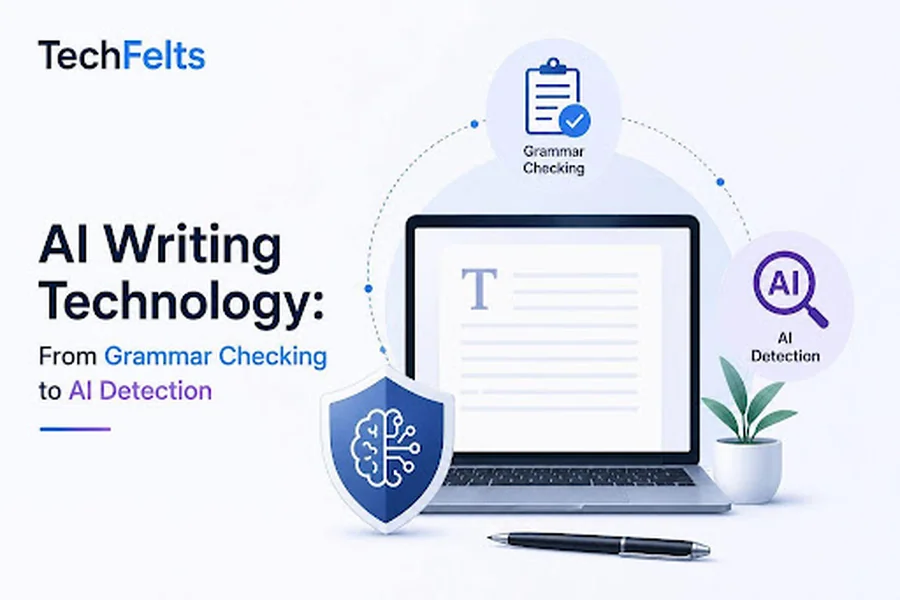
Writing software has moved well beyond spell checking. A single writing workflow can now include tools that suggest changes to grammar and sentence structure, help refine language, and assess text for characteristics associated with AI generation. Grammar Checker and AI Detector tools serve different purposes, and Trinka AI brings both capabilities into a broader writing and review workflow.
The difference matters. A grammar tool evaluates the language on the page. An AI detector evaluates patterns in the text that may be associated with AI generated writing. Neither one can decide whether the underlying information is correct, whether an argument is convincing, or whether a piece of content deserves to be published.
What has changed in writing technology?
For years, digital writing tools were mainly concerned with obvious errors. Spell checkers caught misspelled words. Grammar software identified common sentence level problems. Editors then handled the harder decisions.
AI has expanded the scope of what software can do with text.
Modern writing systems can examine context, suggest alternative wording, identify potential language problems, and work with much larger documents. This has changed the editing process because writers can get feedback earlier instead of waiting until a complete draft reaches an editor.
The result is a faster workflow, but speed creates its own problem. A suggested change can look convincing even when it weakens the meaning of the original sentence. Automated review therefore needs a person who understands the content and can judge whether a recommendation is appropriate.
Where grammar checking fits
Grammar checking remains one of the most practical uses of AI in writing.
A modern Grammar Checker can examine areas such as:
- Grammar
- Spelling
- Punctuation
- Sentence structure
- Word choice
- Clarity
- Readability
Trinka’s Grammar Checker, for example, checks grammar, spelling, punctuation, sentence structure, and word choice in context. It is also designed for academic and technical documents, including research papers, journal manuscripts, theses, dissertations, and technical reports.
That distinction is useful for technical writers and researchers. A sentence containing a specialised term may look unusual to a general purpose writing system but be perfectly correct within its field. The writer still needs to review the recommendation before changing it.
Grammar checking is not fact checking
This is an important boundary.
A grammar tool can identify a problem in a sentence describing a study. It cannot determine whether the study was designed correctly.
It can help improve the wording of a product claim. It cannot establish whether the claim is true.
It can identify a punctuation issue around a citation. It cannot determine whether the source actually supports the statement.
Language quality and factual accuracy are separate editorial tasks.
Where AI detection fits
AI detection addresses a different problem.
An AI Detector examines text for characteristics associated with AI generated writing and provides an assessment based on those characteristics. Trinka’s AI Detector provides an overall AI likelihood score and paragraph level analysis. Its own documentation also states that the result should not be the sole factor used to determine whether content was created by AI.
That limitation is important.
An AI detector sees the submitted text. It does not see every draft, note, edit, or decision behind that text. A result should therefore be interpreted alongside the circumstances surrounding the document.
AI detection is best understood as text analysis, not a window into the author’s complete writing process.
Grammar checking and AI detection answer different questions
The simplest distinction is:
| Tool | What it examines | Main purpose |
| Grammar Checker | Language and sentence construction | Find potential writing problems |
| AI Detector | Characteristics associated with AI generated text | Assess whether text may show AI generation signals |
A Grammar Checker asks:
Is there something about the language that could be improved?
An AI Detector asks:
Does the text contain characteristics associated with AI generated writing?
A document can have excellent grammar and still contain inaccurate information. It can also contain grammar errors and have been written entirely by a person.
The two tools should not be treated as substitutes for each other.
Why human review still matters
The more capable writing software becomes, the easier it is to overlook the decisions that software cannot make.
Consider a technical article describing a new product. An automated system might improve several sentences and make the article easier to read. It might also remove a qualification that limits the original claim.
The revised sentence could sound better while being less accurate.
The same problem can occur with research writing. A suggestion that improves readability may alter the meaning of a technical statement, change the strength of a conclusion, or remove a qualification that matters to the interpretation.
A writer who understands the subject should therefore remain responsible for the final wording.
How AI writing technology fits into a modern workflow
A useful workflow does not require every available AI writing feature.
1. Research the subject
Collect the information needed to support the article. Check primary sources where possible.
2. Write the main argument
Decide what the reader needs to understand before spending time on sentence level refinement.
3. Review the language
Use a Grammar Checker to identify potential problems with grammar, spelling, punctuation, sentence structure, and word choice.
4. Check the changes
Read each recommendation in context. Keep the change only when it improves the sentence without changing its intended meaning.
5. Verify the content
Check names, numbers, dates, quotations, product specifications, links, and other factual details separately.
6. Use AI detection when there is a legitimate reason
An AI Detector can provide an additional assessment when the origin or production of text needs to be examined.
7. Perform a final human review
Read the finished piece as a complete document. Look for gaps in the argument, unsupported claims, missing context, and statements that could be interpreted incorrectly.
The last step remains difficult to reduce to a single automated score because the quality of an article depends on more than the properties of individual sentences.
AI writing technology is also changing editing
Editing used to happen largely after a draft was complete. AI tools allow some forms of review to happen while the document is being written.
A writer can check a paragraph, revise it, continue drafting, and run another check later. A researcher can review language across a manuscript before sending it to a colleague. A content team can identify recurring language problems before publication.
This changes the editor’s role.
Instead of spending all of the available time finding basic errors, an editor can spend more time on structure, evidence, tone, factual accuracy, and whether the content actually answers the reader’s question.
Automation handles some of the inspection. Editorial judgment decides what should change.
The problem with treating AI writing tools as a single category
“AI writing tool” covers several different technologies.
A system that generates a paragraph is doing something different from a tool that checks grammar. A grammar checker is doing something different from an AI detector. A plagiarism checker is looking for something different again.
Those distinctions matter when choosing a tool.
For example:
| Need | Appropriate type of tool |
| Find grammar and spelling problems | Grammar Checker |
| Improve sentence clarity | Grammar Checker or editing tool |
| Generate a first draft | Generative AI writing tool |
| Examine text for AI related characteristics | AI Detector |
| Find matching or reused text | Plagiarism checker |
| Verify whether a claim is supported | Human review and source checking |
Putting all of these functions under the label of “AI writing” can make the technology sound more interchangeable than it actually is.
What writers should check themselves
Even a well edited article needs a final review.
Before publishing, check:
Accuracy: Are the claims supported by reliable information?
Context: Has an important qualification been removed?
Meaning: Did an automated edit change what the writer intended to say?
Evidence: Can important claims be traced to appropriate sources?
Audience: Does the article make sense to the people who will actually read it?
Purpose: Does the content answer the question it was created to address?
These checks sit above sentence level editing. They determine whether the finished content is worth publishing.
The role of AI in technical and professional writing
Technical writing places unusual demands on editing software. The document may contain terminology that is unfamiliar outside a specific field, and small changes can affect the meaning of a technical statement.
This is one reason specialised writing tools can be useful. Trinka describes its Grammar Checker as being designed for academic and technical writing and supports technical vocabulary through features such as a personal dictionary.
The tool can assist with language. The subject matter expert remains responsible for the technical content.
That division of responsibility is likely to remain important as writing technology becomes more capable.
Final Takeaway
AI writing technology has expanded the number of tasks software can handle during the writing and editing process. Grammar checking can help identify language problems, while AI detection provides a separate way to assess text for characteristics associated with AI generated writing.
The useful distinction is not between “AI writing” and “human writing.” It is between what the software can examine and what still requires human judgment.
A good writing workflow uses automation for tasks that benefit from fast, consistent analysis and keeps people responsible for accuracy, meaning, evidence, and the final decision to publish.