
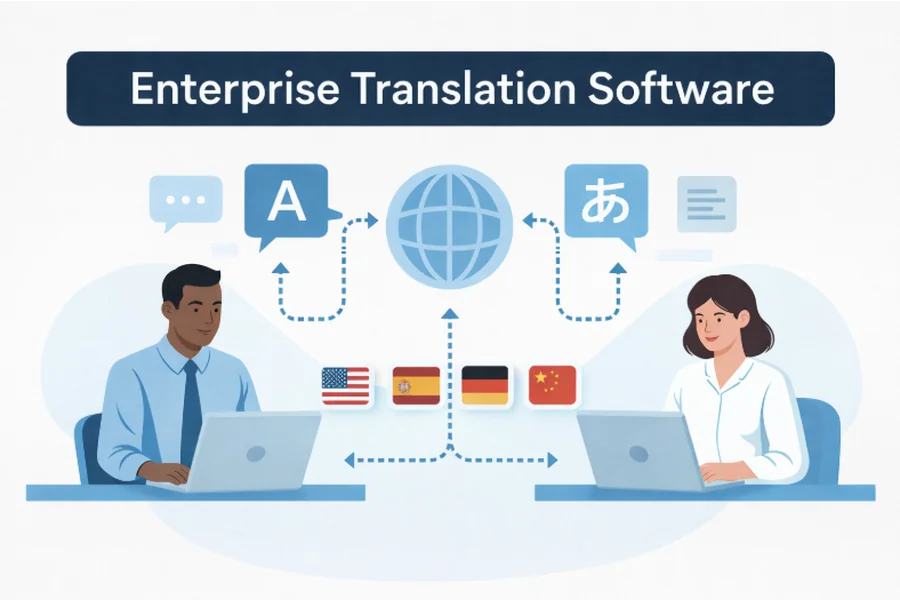
Entering new international markets involves more than simply translating a few web pages – it requires a robust, secure, and intelligent system for managing multilingual content at scale. Today’s enterprise translation platforms have advanced significantly, incorporating automation, AI-powered processes, linguistic quality controls, and deep integrations that allow global businesses to grow faster and more efficiently.
For modern enterprises, translation technology is no longer optional – it is a strategic component of international expansion, localization, marketing, product development, and customer support. The right solution empowers teams to handle multilingual content effectively, minimize manual effort, ensure brand consistency, and accelerate releases without compromising quality.
Here is a detailed overview of the leading enterprise translation platforms, their standout features, and how they support global business operations.
Essential Features of Enterprise Translation Platforms
Enterprise translation software is built with several core capabilities that allow global teams to collaborate smoothly, automate repetitive tasks, and maintain quality across all content types – from marketing materials and user interfaces to legal documents.
1. Centralized Translation Management System (TMS)
A powerful TMS forms the foundation of any enterprise translation tool. It brings together files, teams, workflows, translation memories, terminology databases, and integrations into a single platform, replacing scattered processes with a unified, controlled environment.
Key enterprise benefits include:
- Consolidated project dashboards
- Automated workflows linking content creators, translators, editors, and developers
- Clear version tracking and approval processes
2. Translation Memory (TM)
TM stores past translations and reuses them automatically where relevant, leading to:
- Greater consistency across languages
- Significant cost savings
- Faster project completion
For businesses that update products frequently or operate in 25+ markets, TM is essential.
3. Terminology Management (Glossaries)
Glossaries maintain approved brand and industry terms, ensuring translations are accurate and on-brand. Enterprises use them for:
- Product naming standards
- Industry-specific vocabulary
- Legal and compliance phrasing
4. AI and Machine Translation (MT) Automation
AI-driven MT speeds up translation workflows. Enterprise platforms often combine MT with human review to optimize both speed and quality.
Advanced functionalities include:
- Adaptive MT engines
- MT quality scoring
- Automated content routing based on complexity
5. Built-in Quality Assurance
At scale, quality control is critical. Advanced QA tools automatically detect:
- Terminology inconsistencies
- Missing variables or placeholders
- Layout or formatting issues
- Grammar and punctuation errors
6. Developer-Focused Localization Tools
Businesses translating websites, apps, SaaS platforms, and APIs need:
- String-based localization
- Integrations with GitHub, GitLab, Bitbucket
- CLI tools, webhooks, and REST APIs
- Support for file formats like JSON, XML, YAML, PO, RESX
7. Security and Compliance
Enterprise platforms must adhere to strict security standards, often holding certifications such as:
- ISO 27001
- SOC 2
- GDPR compliance
8. Multilingual SEO Capabilities
Vital for companies with global content strategies. Key features include:
- Hreflang automation
- Keyword localization
- Metadata translation workflows
9. Real-Time Team Collaboration
Large organizations need tools that enable cross-department cooperation, including:
- Multi-role permissions
- Internal review workflows
- Vendor management tools
- Commenting and in-context editing
10. Integration Ecosystem
Enterprise software should connect seamlessly with:
- CMSs (WordPress, Contentful, Sitecore, Adobe Experience Manager)
- Code repositories
- Customer support systems (Zendesk, Intercom)
- Design tools (Figma, Sketch)
- Marketing platforms (HubSpot, Marketo)
Without deep integrations, translation processes become disjointed and slow.
Leading Enterprise Translation Platforms
Selecting the right platform depends not only on features but also on how well the solution meets enterprise needs around security, automation, scalability, workflow flexibility, developer support, and vendor management. Below is an extended look at top platforms and what makes each a strong fit for global operations.
Crowdin
Crowdin offers a modern enterprise translation software solution designed for global SaaS companies, engineering teams, and product-led organizations that release updates regularly. It stands out for its automation strengths and extensive integration ecosystem.
Why enterprises choose Crowdin:
Its architecture enables continuous localization at scale – any change in code, UI text, marketing content, or documentation can automatically trigger translation workflows. Customizable workflows cater to different departments such as product, marketing, support, and legal.
Key advantages:
- Fully automated Git-based workflows (GitHub, GitLab, Bitbucket)
- 400+ integrations with product, marketing, design, and documentation tools
- AI and MT workflow automation with configurable rules
- Interactive in-context translation for websites and apps
- Enterprise-grade security, SSO, and compliance
- Scalable pricing for global teams
Ideal for: Enterprise SaaS, fintech, gaming, and marketplace businesses that require continuous deployment across multiple languages.
Phrase
Phrase is a mature localization platform with a focus on workflow automation, developer productivity, and quality control. It includes a powerful CAT environment integrated into its TMS.
Enterprise benefits:
- Stable infrastructure for large-scale use
- Strong MT engine integrations and quality evaluation tools
- Phrase Orchestrator for building automation workflows
- Collaboration features for internal and external teams
- Broad support for localization file formats
Ideal for: Established tech companies, regulated industries, and enterprises needing predictable, controlled localization environments.
Memsource (Phrase TMS)
Now part of the Phrase ecosystem, Memsource remains a leading TMS for organizations with high translation volumes.
Key reasons enterprises choose Memsource:
- Advanced translation memory system
- MT quality estimation to reduce review costs
- Robust automation and vendor management
- Detailed analytics for productivity, cost, and quality
- Strong security controls and compliance
Ideal for: Enterprises with complex content portfolios and multiple translation vendors.
Smartling
Smartling is a top choice for marketing teams and enterprises that want to combine advanced automation with high-quality human translation. It blends AI-driven MT with sophisticated linguist workflows, making it a strong fit for customer experience, storytelling, and long-form content.
Enterprise strengths:
- Linguistic Quality Assurance (LQA) with scoring
- Advanced visual context for translators
- AI-powered content analysis and quality suggestions
- Centralized vendor and translator management
- Automated content ingestion from CMSs and DAMs
Ideal for: Major retailers, travel platforms, and consumer brands with frequently updated, campaign-driven content.
Transifex
Transifex has long been favored by engineering-driven companies, open-source communities, and organizations managing large datasets.
Enterprise strengths:
- High performance with large-scale data
- Powerful API and developer tools
- Support for fast, continuous localization
- Collaborative interface for cross-functional teams
- Cloud-based, suited for distributed engineering teams
Ideal for: Media, gaming, e-learning, and digital platforms with dynamic content.
Lokalise
Lokalise is popular among tech companies with complex development stacks. Built for product teams, it supports fast, agile localization cycles.
Why engineers prefer Lokalise:
- Strong automation via API, CLI, and SDKs
- Automatic synchronization of UI strings between design, development, and translation
- Support for 150+ file formats
- In-context localization for apps and web interfaces
- Custom workflows and branching
Ideal for: Mobile apps, SaaS dashboards, IoT platforms, and teams using CI/CD pipelines.
SDL Trados Enterprise
SDL Trados is one of the most established names in translation technology, now offered under RWS. It is widely used in enterprises that require rigorous workflows and deep linguistic control.
Why enterprises trust Trados:
- Industry-leading CAT tool used by professional translators
- Strong translation memory and terminology systems
- Workflow configurations for regulated environments
- Hybrid desktop and cloud options
- Long-standing reputation with global corporations
Ideal for: Legal, medical, financial, and government sectors due to its precision and auditability.
Smartcat
Smartcat combines a cloud-based TMS with a global marketplace of translators. It suits enterprises that prefer to manage workflows internally while outsourcing translation work.
Key advantages:
- AI-powered translation combined with marketplace hiring
- Unified workspace for translators, editors, and reviewers
- Automated payments for contractors in 70+ countries
- Strong collaboration capabilities
- Rapid scaling without building in-house vendor teams
Ideal for: Fast-growing companies, consultancies, and agencies managing multilingual content production.
Weglot
Weglot began as a plug-and-play website translation tool and has evolved to support more advanced enterprise workflows. It excels at fast website localization, especially for marketing teams.
Why enterprises choose Weglot:
- No-code integration with most CMS and website builders
- Automatic machine translation for initial drafts
- Simple workflow for human review and editing
- Real-time updates synced to live websites
- SEO-friendly features (automatic hreflang, metadata translation)
Ideal for: Enterprises running multilingual marketing campaigns that require quick deployment and testing.
XTM Cloud
XTM Cloud is a long-standing enterprise TMS designed for high-volume, structured workflows used by Fortune 500 companies.
Enterprise strengths:
- Highly customizable workflows for complex organizations
- Advanced terminology tools and TM engines
- AI and MT orchestration to reduce costs
- Analytics for quality, productivity, and efficiency
- Excellent vendor management tools
Ideal for: Multinational corporations, consumer goods manufacturers, automotive brands, and enterprises managing thousands of SKUs or documents.
FAQs
What is enterprise translation software?
It is a platform that manages, automates, and optimizes translation and localization processes for large organizations. It helps teams translate websites, software, marketing content, support docs, and internal materials at scale with high quality and consistency.
Why do enterprises need dedicated translation software?
Manual translation is slow, error-prone, and doesn’t scale. Enterprise software centralizes files, translators, glossaries, and workflows while offering automation, AI tools, quality checks, and deep integrations.
What type of content can it handle?
- Websites and mobile apps
- UI/UX product strings
- Legal and compliance documents
- Knowledge bases
- Marketing campaigns
- Multilingual SEO content
- E-learning materials
- Product catalogs
What’s the difference between a CAT tool and a TMS?
- CAT (Computer-Assisted Translation): Used by individual translators; includes TM and glossaries.
- TMS (Translation Management System): Manages enterprise-wide translation operations, including workflows, automation, collaboration, integrations, and QA.
Most enterprise platforms combine both.
How much does it cost?
Pricing depends on:
- Number of languages
- Translation volume
- Integrations needed
- Team size and roles
- MT usage
Costs range from $200–$800/month for small teams to $50,000+ annually for large global enterprises.
What is continuous localization and why is it important?
Continuous localization keeps translations updated automatically as source content changes. This prevents outdated or inconsistent multilingual experiences and is key for agile product development.
Which platform is best for SaaS companies?
Crowdin, Lokalise, and Phrase are top choices due to their deep integration with development workflows and support for continuous localization.
Which offers the best automation?
Crowdin, Smartling, and XTM Cloud provide highly flexible, customizable automation workflows for enterprise-scale needs.
Can it improve multilingual SEO?
Yes. With the right workflows, enterprises can:
- Localize keywords
- Automate hreflang tags
- Ensure metadata consistency
- Avoid duplicate content issues
This enhances international search visibility.
How do enterprises integrate it with their tech stack?
Through:
- Native integrations (CMSs, Git, design tools, support platforms)
- APIs
- CLI tools
- Webhooks
- Automated pull/push setups
This enables smooth content movement through development, translation, review, and deployment.
Conclusion
Enterprise translation software is a strategic investment for any organization scaling globally. With AI-driven automation, robust collaboration tools, and deep integrations, platforms like Crowdin, Smartling, Lokalise, and XTM Cloud enable teams to deliver high-quality multilingual content faster and more efficiently than ever.
Whether you’re a SaaS company entering new regions, a multinational supporting dozens of markets, or an e-commerce platform serving customers worldwide, the right translation platform becomes the backbone of your global growth strategy.